

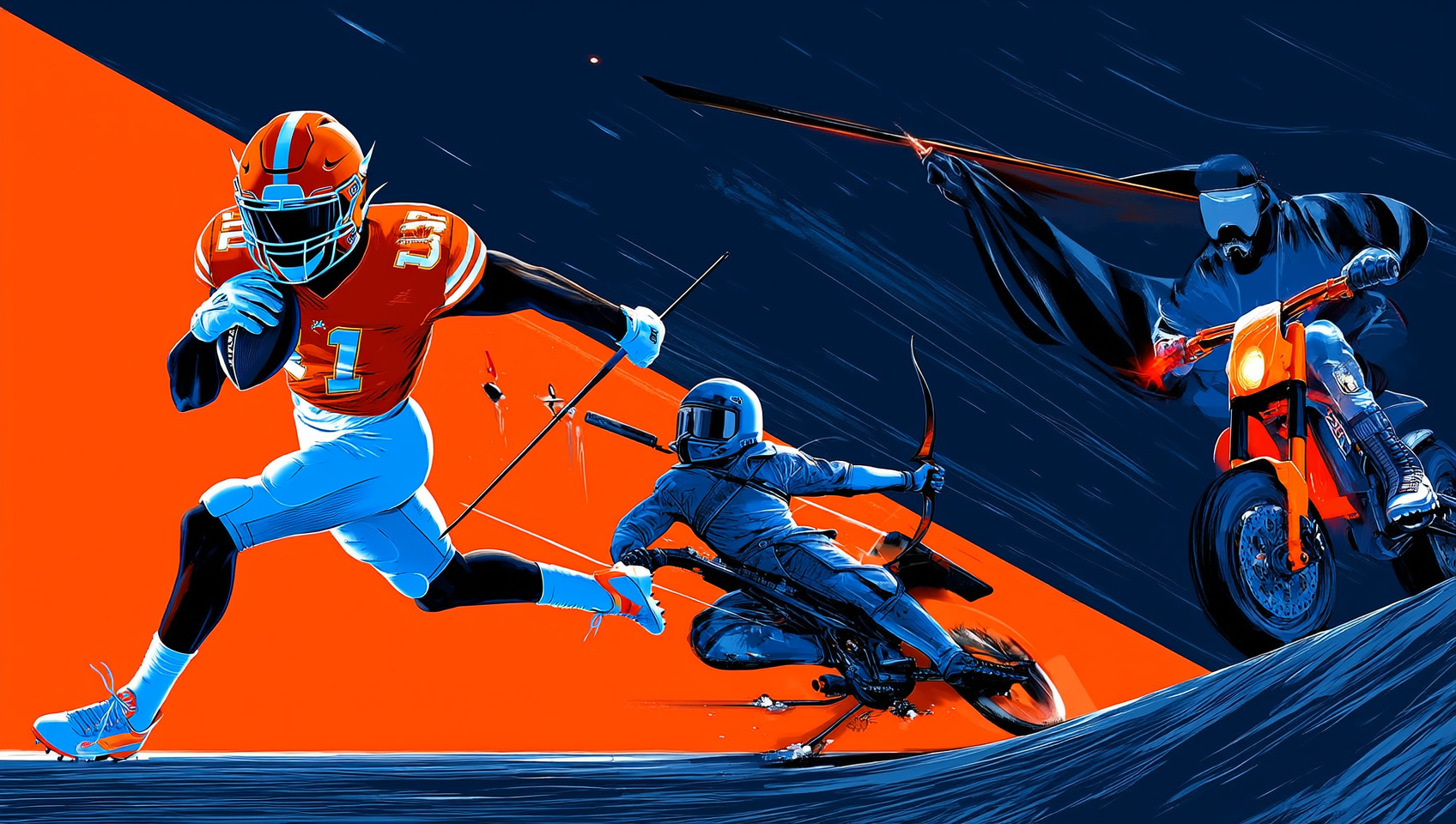
Most browser sports games get worse the harder they chase realism. The browser sports games that stay worth replaying do the opposite: they carve competition down to one pressure point and make you live there, whether that means saving a bad bike landing or throwing into a lane that is closing right now.
A browser tab will not beat a full sim on scale, controls, or broadcast gloss. It can beat one on focus. The smart games strip the sport to its tension, keep sessions short, and make every mistake obvious.
Most Browser Sports Games Collapse When They Try to Be Mini Sims
Too many browser sports games still confuse quantity with credibility. They bolt on empty upgrade trees, dead menus, or rules borrowed from bigger franchises without understanding what actually creates pressure. A game can resemble a sport and still miss the point entirely.
These four avoid that trap by picking a narrower target. Moto Bike Extreme Hill Stunts is about recovery, Flag Football Game is about space, Archery Master Bow and Arrow is about shot discipline, and Punch Champions is about rhythm. None of that sounds expansive, which is precisely why it works in a browser.
Use that as the test. Ask what single mistake a game punishes better than anything else. If the answer is fuzzy, the design probably is too.
Moto Bike Extreme Hill Stunts Proves Recovery Matters More Than Speed
The first surprise in Moto Bike Extreme Hill Stunts is that the throttle is not your main relationship with the game; the bike's center of gravity is. Steep climbs tempt you to force the pace, but the track design keeps asking a sharper question: can you land crooked, correct the front wheel, and still carry enough momentum into the next ramp? That is why the flips matter. They are not empty stunt garnish. Every rotation threatens the angle of the next touchdown, so style and survival keep colliding. When a course chains a sharp takeoff, an awkward landing zone, and one more incline than seems reasonable, the whole run becomes a conversation with physics rather than a sprint to the finish.

Moto Bike Extreme Hill Stunts
You spend most of your time managing the bike’s balance, not just holding the throttle, and that is what gives this hill stunt racer some bite. The courses lean hard on steep climbs, awkward landings, and jumps that punish sloppy timing, so every clean run feels earned. You will be popping into flips for extra style, then immediately correcting the front wheel so you do not slam into the next ramp. The mountain and platform-heavy layouts keep the action moving, but the real hook is the way the physics force you to respect momentum. Push too hard and you overshoot. Hesitate and you lose the hill. It is at its best when a track looks simple, then turns into a chain of precise takeoffs and sketchy recoveries. If you like bike games that reward control over chaos, this one lands well.
Play Now
That makes the game better than the average browser stunt racer, which often mistakes speed for drama. Speed is easy. Recovery is hard. Moto Bike Extreme Hill Stunts understands that the tense part of bike control is not blasting off the jump; it is surviving the second after the jump without wasting the momentum you fought to build.
Tracks that look simple on first glance expose sloppy habits fast. Overshoot a landing and the next hill stalls you out. Get timid and you never crest the climb. That constant correction gives the game a physical honesty that many bigger browser racers never reach.
Flag Football Game Turns Every Possession Into a Spacing Test
Flag Football Game gets sharper the moment you stop treating it like a stripped-down football sim and start treating it like a map-control game. The flag-pull rules remove the fantasy of bulldozing through traffic, which puts all the weight on lane choice, timing, and the geometry of defenders closing from different angles. A pass that feels safe for one extra beat suddenly is not. A cut into open grass matters because space evaporates quickly and drives can die on a single bad read. That cleaner arcade rhythm is the whole appeal: possessions move fast, deficits feel urgent, and every successful play comes from noticing where the field is about to open rather than where it opened a second ago.

Flag Football Game
You’re playing a lighter, quicker version of football where space matters more than brute force. Instead of grinding out contact, the fun comes from reading the field, slipping into open lanes, and choosing the right moment to pass before a defender closes in. Matches feel snappier than a full sim, which makes each possession matter and keeps the pressure on when you fall behind. The flag-pull setup gives the game a clean, arcade rhythm: one mistake can stop a drive fast, but a smart cut or well-timed throw can flip momentum just as quickly. It works best when you treat it like a positioning game rather than a power fantasy. If you like sports games that reward awareness and quick decisions over complicated systems, this one is easy to settle into and tough to play carelessly.
Play Now
This is where a lot of browser football games go wrong. They chase the visual language of the sport, then flatten the tactical language. Flag Football Game moves in the opposite direction. By shrinking the physical contact and speeding up the consequences, it makes awareness more valuable than brute-force fantasy.
That trade-off keeps matches readable even in short sessions. You do not need a thick playbook to feel the pressure. You need one defender taking away your first option and just enough time to prove you saw the second.
Archery Master Bow and Arrow Finds Pressure in Scarcity, Not Spectacle
Archery Master Bow and Arrow finds tension through subtraction. You get a target, a limited supply of arrows, and almost no padding around the core act of drawing, settling, and releasing. That limited-arrow structure matters more than it sounds. A careless shot does not just trim your score; it steals one of your chances to repair the round, which changes the mood of every release after the first miss. The game becomes a small study in self-control: do you rush because the target looks generous, or do you let the aim settle, accept the pause, and trust the shot? Its sessions are short enough to invite immediate retries, but the reason you retry is specific. You want a cleaner sequence of decisions, not a louder spectacle.

Archery Master Bow and Arrow
You’re working with a simple target-shooting setup here: a bow, a small supply of arrows, and the pressure to make each shot count. That limited-arrow structure gives the game more tension than the usual casual sports clicker, because a bad release doesn’t just hurt your score, it wastes one of your chances to recover. The main appeal is chasing a cleaner round each time, learning how long to draw, watching your aim settle, and trying not to rush the release when the target looks easy. It’s light, direct, and built around repetition in a good way, with quick sessions that make retrying feel natural instead of tiring. There isn’t much extra decoration around the core idea, but that also keeps the focus where it should be: judging angle, timing your shot, and squeezing the most points possible out of a short run.
Play Now
That is a valuable distinction inside browser sports games. Too many so-called casual sports titles rely on endless taps, sloppy feedback, or a blur of rewards to fake momentum. Archery Master Bow and Arrow does not fake much. It puts pressure on angle, timing, and restraint, then lets the quiet of the setup do the work.
Because the format is so bare, improvement becomes easy to feel. You notice the moment your releases stop being hopeful and start being deliberate. In a browser, that kind of clarity is worth more than a dozen extra modes.
Punch Champions Understands That Good Boxing Games Are About Waiting
Punch Champions saves its best idea for players who can resist the urge to swing first. The ladder of eight opponents gives the game a clean arcade shape, but the real design win is how often it rewards waiting half a beat longer. Opponents telegraph openings, bait reckless attacks, and punish button-mash habits almost immediately. A quick dodge can matter more than squeezing in one more punch because short exchanges flip momentum fast and health disappears quickly once you are out of rhythm. That balance between offense and survival keeps each bout legible. You are not trying to memorize a pile of systems; you are learning the pace at which a fight stops being yours.

Punch Champions
You work through a straight ladder of boxers, and the appeal is in reading each fight’s rhythm rather than wildly throwing punches. Punch Champions keeps things simple on the surface, but it pushes you to notice when an opponent is open, when they’re baiting you, and when a quick dodge matters more than one extra swing. The roster of eight challengers gives the game a clean arcade structure, so every bout feels like a step toward the belt instead of a random exhibition. What stands out is the pace: short exchanges, sudden momentum shifts, and constant pressure to balance offense with survival. If you play recklessly, you get punished fast. If you stay patient, mix your shots, and wait for mistakes, the matches become much more satisfying. It’s a lean boxing game that understands timing better than spectacle.
Play Now
That is why Punch Champions lands harder than many lightweight boxing browser games. It does not confuse noise for intensity. The tension comes from reading patterns, stealing a clean opening, and knowing when patience is the aggressive choice.
Boxing works especially well in a browser when the game respects tempo. Punch Champions does. The loss screen usually feels traceable to one bad habit, which is frustrating in the right way: you can name the mistake, so you can fix it.
The Best Browser Sports Games Feel Smaller Because Their Decisions Hit Harder
The common thread across all four games is not sport type. It is editorial discipline. Each one cuts away the clutter that would make a console game feel complete and a browser game feel bloated. What stays behind is the decision that actually creates tension: balance the landing, spot the lane, settle the aim, wait for the opening.
That is the lesson more browser sports games should learn. The genre does not need more fake scale. It needs more conviction about what deserves the player's attention. When a browser game knows its pressure point, short sessions stop feeling slight. They start feeling concentrated.
So skip the tabs promising a whole season's worth of features in a tiny window. Open the one that targets your weakest habit instead. Play Moto Bike Extreme Hill Stunts if you overcommit, Flag Football Game if you read too late, Archery Master Bow and Arrow if you rush clean mechanics, and Punch Champions if patience collapses under pressure. Give each one three honest runs and pay attention to the first mistake it punishes. That mistake is the game, and it is the fastest way to tell which browser sports games deserve another tab.
Frequently Asked
Quick Answers
The good ones do not try to recreate an entire sport. They isolate one source of pressure and build the session around it. In this group, that means recovery in Moto Bike Extreme Hill Stunts, spacing in Flag Football Game, shot discipline in Archery Master Bow and Arrow, and timing in Punch Champions. When failure is readable and improvement is easy to feel, short sessions stop feeling throwaway.
In a browser, arcade structure usually wins because it respects the format. A tab is better at delivering one sharp decision loop than a watered-down version of a full console sim. That does not mean browser sports games have to be shallow. It means they need to choose the right level of focus and stop pretending scale is the same thing as depth.
Archery Master Bow and Arrow is the cleanest fit for very short runs because a round is compact and every arrow matters immediately. Punch Champions is close behind if you want fast tension, since each fight reveals your timing habits quickly. Flag Football Game and Moto Bike Extreme Hill Stunts also work in short bursts, but they ask for a bit more rhythm and adjustment before their best moments show up.
Because they add surface features without adding sharper decisions. Menus, upgrades, and visual imitation can make a game look bigger while leaving the core interaction flat. Once you judge the genre by what mistake a game punishes best, shallow design becomes easy to spot. If the answer is vague, the replay value usually disappears just as fast.
Sources
What This Piece Builds On
google_trends · Google Trends browser games·google.com · April 22, 2026
Google Trends rising query around "browser games" with recent interest.
google_trends · Google Trends browser games·google.com · April 22, 2026
Google Trends rising query around "browser games" with recent interest.
Need a different starting point?
Curated landing pages built around what players actually came for — not raw filter results.
Play on ArcadeZone
Linked Games
Moto Bike Extreme Hill Stunts
You spend most of your time managing the bike’s balance, not just holding the throttle, and that is what gives this hill stunt racer some bite. The courses lean hard on steep climbs, awkward landings, and jumps that punish sloppy timing, so every clean run feels earned. You will be popping into flips for extra style, then immediately correcting the front wheel so you do not slam into the next ramp. The mountain and platform-heavy layouts keep the action moving, but the real hook is the way the physics force you to respect momentum. Push too hard and you overshoot. Hesitate and you lose the hill. It is at its best when a track looks simple, then turns into a chain of precise takeoffs and sketchy recoveries. If you like bike games that reward control over chaos, this one lands well.
Play →
Flag Football Game
You’re playing a lighter, quicker version of football where space matters more than brute force. Instead of grinding out contact, the fun comes from reading the field, slipping into open lanes, and choosing the right moment to pass before a defender closes in. Matches feel snappier than a full sim, which makes each possession matter and keeps the pressure on when you fall behind. The flag-pull setup gives the game a clean, arcade rhythm: one mistake can stop a drive fast, but a smart cut or well-timed throw can flip momentum just as quickly. It works best when you treat it like a positioning game rather than a power fantasy. If you like sports games that reward awareness and quick decisions over complicated systems, this one is easy to settle into and tough to play carelessly.
Play →
Archery Master Bow and Arrow
You’re working with a simple target-shooting setup here: a bow, a small supply of arrows, and the pressure to make each shot count. That limited-arrow structure gives the game more tension than the usual casual sports clicker, because a bad release doesn’t just hurt your score, it wastes one of your chances to recover. The main appeal is chasing a cleaner round each time, learning how long to draw, watching your aim settle, and trying not to rush the release when the target looks easy. It’s light, direct, and built around repetition in a good way, with quick sessions that make retrying feel natural instead of tiring. There isn’t much extra decoration around the core idea, but that also keeps the focus where it should be: judging angle, timing your shot, and squeezing the most points possible out of a short run.
Play →
Punch Champions
You work through a straight ladder of boxers, and the appeal is in reading each fight’s rhythm rather than wildly throwing punches. Punch Champions keeps things simple on the surface, but it pushes you to notice when an opponent is open, when they’re baiting you, and when a quick dodge matters more than one extra swing. The roster of eight challengers gives the game a clean arcade structure, so every bout feels like a step toward the belt instead of a random exhibition. What stands out is the pace: short exchanges, sudden momentum shifts, and constant pressure to balance offense with survival. If you play recklessly, you get punished fast. If you stay patient, mix your shots, and wait for mistakes, the matches become much more satisfying. It’s a lean boxing game that understands timing better than spectacle.
Play →