

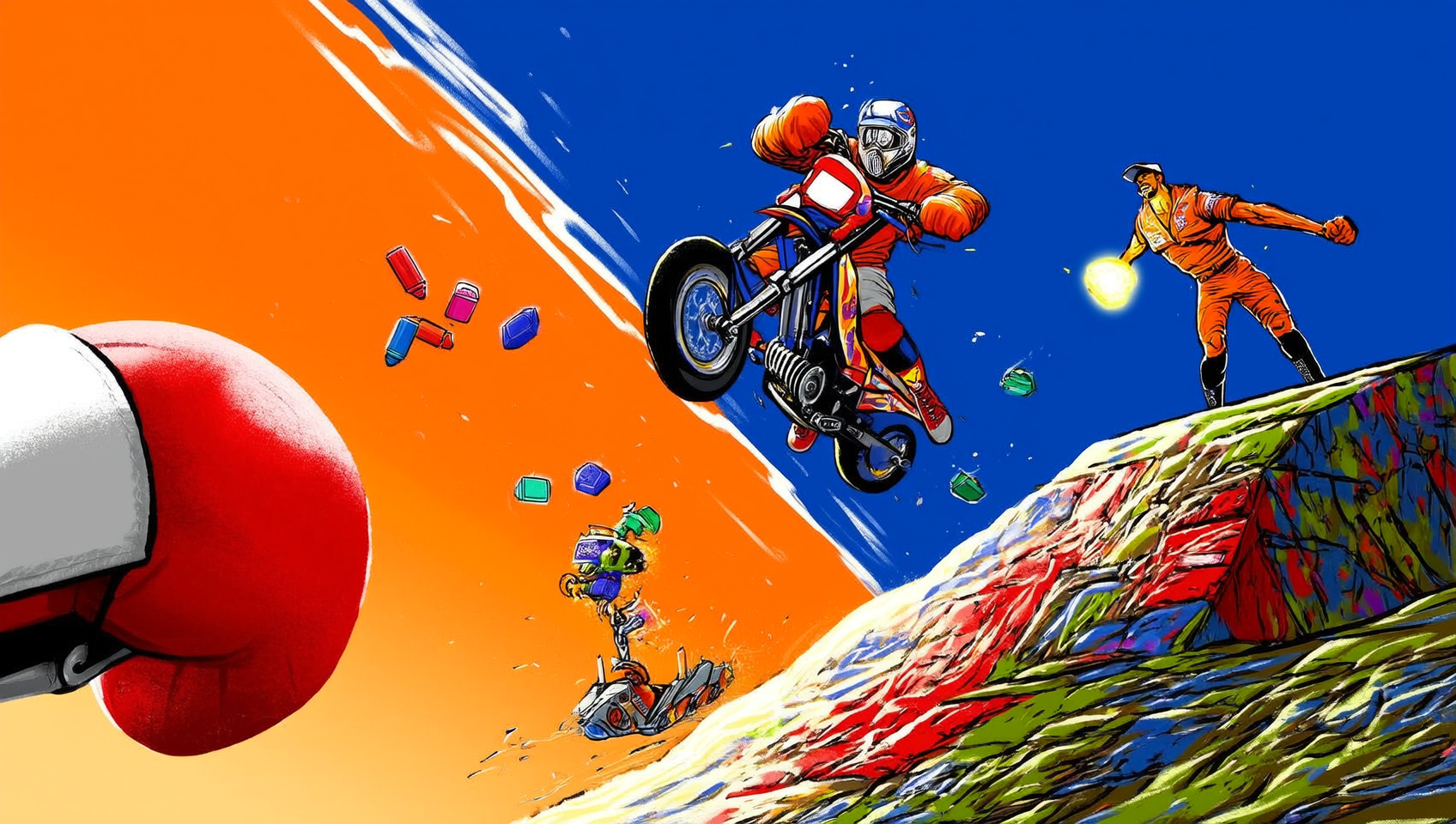
Three picks to play right now

Sports
Punch Champions
You work through a straight ladder of boxers, and the appeal is in reading each fight’s rhythm rather than wildly throwing punches. Punch Champions keeps things simple on the surface, but it pushes you to notice when an opponent is open, when they’re baiting you, and when a quick dodge matters more than one extra swing. The roster of eight challengers gives the game a clean arcade structure, so every bout feels like a step toward the belt instead of a random exhibition. What stands out is the pace: short exchanges, sudden momentum shifts, and constant pressure to balance offense with survival. If you play recklessly, you get punished fast. If you stay patient, mix your shots, and wait for mistakes, the matches become much more satisfying. It’s a lean boxing game that understands timing better than spectacle.
Match-3
Color Jam 3D
You’re not lining up gems here; you’re managing a stream of crayons and trying not to clog your own workspace. Each move sends a crayon into a limited set of slots, and the real trick is deciding which colors to release first so you can clear triples and gradually complete the picture. That small bit of traffic management gives the puzzle its bite. Blocked crayons add just enough friction to keep you from playing on autopilot, because freeing the right piece can open the whole board. The coloring theme also helps the game stand out from a standard match-3 clone. Watching an image fill in as you solve makes every clean sequence feel more satisfying than a plain score chase. It stays relaxed, but there’s a steady undercurrent of planning that keeps later stages from turning mindless.

Sports
Letter Boom Blast Rush
You’re not just swinging at targets here; you’re shaving letters off chunky word blocks so your runner has a clean lane to the end. That small twist gives the whole thing a nice puzzle-sports rhythm. Each shot asks you to read fast, pick the useless letters, and avoid wrecking the word in a way that leaves extra obstacles standing. The baseball setup keeps it lively, but the real hook is timing your hits under pressure while the stage keeps pushing you forward. It’s lighter and sillier than a straight word game, yet there’s enough decision-making to keep it from feeling automatic. The best moments come when you spot the solution instantly and clear a path with one neat swing. It’s simple, quick to understand, and surprisingly satisfying when your aim and word sense line up.
The rise of web store games says something sharper than a typo ever could. Players typing that phrase are not confused about where browser games live; they are asking the one question the browser makes brutally unavoidable: will this hook me immediately? Recent Google Trends signals around 'web store games,' 'web store,' and 'online browser games' all tilt upward, but the revealing part is not the volume. It is the wording.
The browser is no longer treated like a budget version of a storefront. It behaves like an audition room. A download used to buy a game several polite minutes of patience. A tab gets seconds. That changes design. The best web store games do not explain themselves slowly, and they certainly do not ask you to trust that the good part shows up later. They put the central decision in front of you at once, then prove that it has edge, consequence, and a reason to come back.
Web Store Games Is a Clumsy Phrase for a Sharp New Expectation
The awkwardness of the phrase is the clue. 'Web store games' mashes together two expectations that used to live apart: the curation promise of an app store and the instant access of browser play. People are not asking for a literal store. They are asking for pre-filtered certainty. They want browser games that already seem worth the click before the first mistake, the first ad, or the first moment of doubt.
Recent trend scores around 88 for 'web store games,' 86 for 'web store,' and 100 for 'online browser games' do not just show curiosity. They show convergence. Players have started borrowing storefront language because the browser has trained them to judge faster and leave faster. Catalog size used to sound impressive. Now abundance is often the problem. Too many choices, too many cheap imitations, too many games that do not reveal their real idea until three minutes too late.
That leak from store language into browser language is revealing. App stores trained players to think in terms of charts, filtering, and quick recommendation. The browser trained them to close a tab the second a game feels vague. Put those behaviors together and you get web store games: a clumsy phrase that really means show me the good stuff, and show me now.
A few years ago, sheer variety could sell the medium. Now the browser is competing with interruption, not with consoles. People open games beside work tabs, messages, or a dying phone battery. That is why a game like Punch Champions makes sense as evidence for the trend: its core tension is readable on sight. You understand the rhythm before you master it. The same is true, in completely different genres, of Color Jam 3D and Russian Treasure Hunter. These games are not winning because they are small. They are winning because they are legible.
Punch Champions Proves Readable Tension Beats Spectacle in the Browser
The opening exchanges in Punch Champions do more for the web store games trend than any marketing blurb could. You are not rewarded for flailing. You are rewarded for seeing. Each opponent teaches the same lesson from a slightly meaner angle: wait for the opening, notice the bait, dodge before greed gets you clipped. That matters because the browser punishes ambiguity. Punch Champions never leaves you wondering what the game wants from you. It wants timing, patience, and nerve, and it demonstrates that in one bout. The ladder of eight challengers gives the whole thing an arcade spine, so every win feels like progress toward a belt rather than another disposable exhibition. Most importantly, its tension is front-loaded. One rushed combo, one missed dodge, and the game explains itself through consequence instead of tutorial text.
Punch Champions
You work through a straight ladder of boxers, and the appeal is in reading each fight’s rhythm rather than wildly throwing punches. Punch Champions keeps things simple on the surface, but it pushes you to notice when an opponent is open, when they’re baiting you, and when a quick dodge matters more than one extra swing. The roster of eight challengers gives the game a clean arcade structure, so every bout feels like a step toward the belt instead of a random exhibition. What stands out is the pace: short exchanges, sudden momentum shifts, and constant pressure to balance offense with survival. If you play recklessly, you get punished fast. If you stay patient, mix your shots, and wait for mistakes, the matches become much more satisfying. It’s a lean boxing game that understands timing better than spectacle.
Play Now
That is the browser ideal in miniature. The hook is immediate, but it is not cheap. Punch Champions earns attention by making every early mistake interpretable. You know why you got punished, and you know what the next attempt needs. When players search web store games, this is what they are really screening for: not maximum content, but maximum clarity about why failure happened and why the next try might go differently.
Color Jam 3D and Letter Boom Blast Rush Show That Instant Clarity Can Still Surprise You
Quick-read browser games are often dismissed as disposable because their premise fits in a sentence. That misses the real design trick. The best web store games compress the explanation, not the decision-making. They get you moving before boredom arrives, then quietly add friction. Color Jam 3D and Letter Boom Blast Rush do that with totally different textures: one looks relaxed, the other looks ridiculous and kinetic, but both hide their bite inside an instantly readable first action.
Color Jam 3D understands that a soft aesthetic can be an excellent decoy. At first glance, it looks like another breezy color-matching exercise. Then the slot management starts mattering. Every crayon you release competes for limited space, blocked pieces gum up future options, and clearing triples becomes less about matching colors than about preventing your workspace from collapsing under its own traffic. The smartest choice is often not the obvious one, because freeing a trapped color can open the whole board a move later. The coloring payoff matters too. Watching the image fill in is not just decoration; it is visible evidence that your sequencing choices are repairing chaos. That makes the first minute readable and the fifth minute more interesting than the premise initially suggests.
Color Jam 3D
You’re not lining up gems here; you’re managing a stream of crayons and trying not to clog your own workspace. Each move sends a crayon into a limited set of slots, and the real trick is deciding which colors to release first so you can clear triples and gradually complete the picture. That small bit of traffic management gives the puzzle its bite. Blocked crayons add just enough friction to keep you from playing on autopilot, because freeing the right piece can open the whole board. The coloring theme also helps the game stand out from a standard match-3 clone. Watching an image fill in as you solve makes every clean sequence feel more satisfying than a plain score chase. It stays relaxed, but there’s a steady undercurrent of planning that keeps later stages from turning mindless.
Play Now
Letter Boom Blast Rush works for the same reason, but it translates the idea into pressure. The baseball swing is the bait; the real hook is fast lexical triage. You are shaving useless letters off chunky word blocks so your runner gets a clean path, which means every shot blends reflex, word recognition, and restraint. Swing at the wrong letter and you do not just lose time, you preserve the obstacle you should have erased. Spot the disposable letters quickly, and the stage suddenly feels elegant instead of cluttered. The game's best moments arrive when you read the answer before the animation catches up with your hand. That tiny flash of 'I saw it first' is exactly the kind of immediate reward browser players chase when they type broad search terms like web games or web store games.
Letter Boom Blast Rush
You’re not just swinging at targets here; you’re shaving letters off chunky word blocks so your runner has a clean lane to the end. That small twist gives the whole thing a nice puzzle-sports rhythm. Each shot asks you to read fast, pick the useless letters, and avoid wrecking the word in a way that leaves extra obstacles standing. The baseball setup keeps it lively, but the real hook is timing your hits under pressure while the stage keeps pushing you forward. It’s lighter and sillier than a straight word game, yet there’s enough decision-making to keep it from feeling automatic. The best moments come when you spot the solution instantly and clear a path with one neat swing. It’s simple, quick to understand, and surprisingly satisfying when your aim and word sense line up.
Play Now
Neither game needs a long ramp because both establish trust almost immediately. What you think you are clicking on and what the game actually becomes are close enough to feel honest, different enough to keep you alert. That honesty is underrated. Browser players forgive short sessions and modest scope. They do not forgive bait-and-switch design or five empty minutes before the first real decision.
Moto Bike Extreme Hill Stunts Turns Physics Into a Sales Pitch
Moto Bike Extreme Hill Stunts sells itself through balance, which is a smarter browser hook than spectacle. The steep climbs, awkward landings, and sketchy jumps tell you right away that simply holding the throttle will not be enough. You pop into a flip for style, then immediately have to correct the front wheel before the next ramp punishes your bravado. That constant negotiation with momentum is the point. The tracks look straightforward until the chain of takeoffs and recoveries exposes how precise your body timing needs to be. A lesser web game would hide its depth behind unlocks. This one puts the central truth on the first hill: respect the physics or crash. That is clean communication, and it is why the game feels tailored to browser behavior rather than compromised by it.

Moto Bike Extreme Hill Stunts
You spend most of your time managing the bike’s balance, not just holding the throttle, and that is what gives this hill stunt racer some bite. The courses lean hard on steep climbs, awkward landings, and jumps that punish sloppy timing, so every clean run feels earned. You will be popping into flips for extra style, then immediately correcting the front wheel so you do not slam into the next ramp. The mountain and platform-heavy layouts keep the action moving, but the real hook is the way the physics force you to respect momentum. Push too hard and you overshoot. Hesitate and you lose the hill. It is at its best when a track looks simple, then turns into a chain of precise takeoffs and sketchy recoveries. If you like bike games that reward control over chaos, this one lands well.
Play Now
Physics games keep thriving in the browser because failure is legible. When you overshoot a landing in Moto Bike Extreme Hill Stunts, the screen does not feel unfair or unreadable. It feels precise. The game told you the rule, you tested it, and the result came back instantly. That is the quickest possible proof of quality in a medium where players are always one tab switch away from leaving.
Russian Treasure Hunter Hooks by Making Patience Legible
The strongest rebuttal to the idea that an instant hook requires instant noise is Russian Treasure Hunter. This is a slower, more methodical loop, yet it still fits the web store games trend because its promise is readable from the start. Scan the ground. Watch the detector. Decide whether the signal is worth the time, the space in your bag, and the risk of staying out longer before heading back to sell. That is the entire fantasy, and the first few minutes already contain it. The detector creeping upward creates anticipation without cutscenes. The backpack turns greed into a math problem. Selling your finds gives each outing an economic aftertaste, so even a cautious run feels like part of a longer strategy instead of dead time. The beauty of the game is not speed; it is how honestly it reveals the loop it plans to refine.

Russian Treasure Hunter
You spend most of your time reading a detector, judging when a promising patch of ground is worth the effort, and deciding whether one more sweep is smarter than heading back to town. That push and pull gives this mining sim its personality. It is not about flashy action; it is about patience, route choices, and the small thrill of noticing the signal creep upward before you finally dig. Selling what you find adds a steady economic layer, so every outing feels like a risk-reward calculation instead of a simple scavenger hunt. The backpack management matters more than you expect, because a careless haul can turn a productive run into a wasted one. What stands out is how methodical the loop feels: scan, commit, extract, cash out, upgrade, repeat. If you like slow-burn progression and tidy decision-making, this has a satisfying rhythm.
Play Now
That is important because browser players are not allergic to patience. They are allergic to uncertainty about whether patience will pay off. Russian Treasure Hunter tells you immediately what your decisions mean. It does not confuse slowness with mystery. In other words, it earns trust the same way Punch Champions does, even though one is about reading punches and the other is about reading a detector.
What the Best Web Store Games Understand About Modern Attention
Modern attention is often described as ruined, but browser behavior looks more selective than broken. Players are not demanding that everything explode in the opening seconds. They are demanding that the game declare its terms. The best web store games do three things almost immediately: they reveal the core action, they show the risk attached to that action, and they promise that mastery will change the result. Punch Champions does it through timing. Color Jam 3D does it through board traffic. Letter Boom Blast Rush does it through instant word recognition under pressure. Moto Bike Extreme Hill Stunts does it through physics. Russian Treasure Hunter does it through a visible risk-reward loop.
That is why the rising phrasing matters. 'Store' here is emotional, not literal. It means players want the certainty a storefront promises and the speed a browser provides. They want to browse less and judge faster. They want a game that does not hide its personality behind installation, monetization, or friction. The browser is perfect for that kind of design because it strips away excuses. Either the loop sparks immediately or it does not.
The browser is acting like a taste test, not a warehouse. So when players search web store games, the real translation is simple: show me something that can win the case for itself right now. Not in an hour. Not after ten currencies and a season pass. Right now. The browser games that keep rising are the ones confident enough to answer that demand with a mechanic instead of a promise.
Game-Page Links
More ArcadeZone Picks
Sports
Punch Champions
You work through a straight ladder of boxers, and the appeal is in reading each fight’s rhythm rather than wildly throwing punches. Punch Champions keeps things simple on the surface, but it pushes you to notice when an opponent is open, when they’re baiting you, and when a quick dodge matters more than one extra swing. The roster of eight challengers gives the game a clean arcade structure, so every bout feels like a step toward the belt instead of a random exhibition. What stands out is the pace: short exchanges, sudden momentum shifts, and constant pressure to balance offense with survival. If you play recklessly, you get punished fast. If you stay patient, mix your shots, and wait for mistakes, the matches become much more satisfying. It’s a lean boxing game that understands timing better than spectacle.
Match-3
Color Jam 3D
You’re not lining up gems here; you’re managing a stream of crayons and trying not to clog your own workspace. Each move sends a crayon into a limited set of slots, and the real trick is deciding which colors to release first so you can clear triples and gradually complete the picture. That small bit of traffic management gives the puzzle its bite. Blocked crayons add just enough friction to keep you from playing on autopilot, because freeing the right piece can open the whole board. The coloring theme also helps the game stand out from a standard match-3 clone. Watching an image fill in as you solve makes every clean sequence feel more satisfying than a plain score chase. It stays relaxed, but there’s a steady undercurrent of planning that keeps later stages from turning mindless.
Sports
Letter Boom Blast Rush
You’re not just swinging at targets here; you’re shaving letters off chunky word blocks so your runner has a clean lane to the end. That small twist gives the whole thing a nice puzzle-sports rhythm. Each shot asks you to read fast, pick the useless letters, and avoid wrecking the word in a way that leaves extra obstacles standing. The baseball setup keeps it lively, but the real hook is timing your hits under pressure while the stage keeps pushing you forward. It’s lighter and sillier than a straight word game, yet there’s enough decision-making to keep it from feeling automatic. The best moments come when you spot the solution instantly and clear a path with one neat swing. It’s simple, quick to understand, and surprisingly satisfying when your aim and word sense line up.
Simulation
Russian Treasure Hunter
You spend most of your time reading a detector, judging when a promising patch of ground is worth the effort, and deciding whether one more sweep is smarter than heading back to town. That push and pull gives this mining sim its personality. It is not about flashy action; it is about patience, route choices, and the small thrill of noticing the signal creep upward before you finally dig. Selling what you find adds a steady economic layer, so every outing feels like a risk-reward calculation instead of a simple scavenger hunt. The backpack management matters more than you expect, because a careless haul can turn a productive run into a wasted one. What stands out is how methodical the loop feels: scan, commit, extract, cash out, upgrade, repeat. If you like slow-burn progression and tidy decision-making, this has a satisfying rhythm.
Related Posts
Keep Reading


Frequently Asked
Quick Answers
It usually does not mean players are searching for a literal web storefront. The phrase blends store-style curation with browser speed. In practice, people using it are often asking for browser games that prove their appeal immediately, with low friction and mechanics that make sense from the first click.
Because browser play usually happens in crowded attention spaces: work breaks, spare minutes, multiple tabs, phones, and quick detours. In that environment, players do not give a game a long onboarding runway. They want the core action, the risk, and the payoff loop visible almost instantly so they can decide fast whether it deserves more time.
No. The strongest browser games explain themselves quickly but deepen through consequence. Punch Champions starts as simple timing, then becomes opponent reading. Color Jam 3D looks relaxed, then turns into traffic management. Fast legibility is not the same thing as low depth; it is usually a sign of disciplined design.
Punch Champions is the clearest example of immediate, readable tension. Color Jam 3D and Letter Boom Blast Rush are strong picks if you want instant comprehension with a twist. Moto Bike Extreme Hill Stunts shows how physics can be the hook, while Russian Treasure Hunter proves that even slower browser games fit the trend when the risk-reward loop is obvious from the start.
Sources
What This Piece Builds On
google_trends · Google Trends web games·google.com · April 26, 2026
Google Trends rising query around "web games" with recent interest.
google_trends · Google Trends web games·google.com · April 26, 2026
Google Trends rising query around "web games" with recent interest.
google_trends · Google Trends browser games·google.com · April 26, 2026
Google Trends rising query around "browser games" with recent interest.
Need a different starting point?
Curated landing pages built around what players actually came for — not raw filter results.